
Flow Friday
Achieving Flow at the Speed of Light


How Formula One Drivers approach the Flow State
Have you ever had a moment in your life like this:
- Everything around you slows down to a grinding halt
- All intrusive thoughts disappear like clouds evaporating from the sky
- Your body moving on its own like a well-oiled machine
- You know exactly what to do without any effort
Like a fleeting moment in time, the flow state comes and goes unannounced.
Wouldn’t it be nice if you could achieve flow on command?
You are not alone.
The flow state has long been the holy grail of peak performance among athletes.
Today we are going to look into how Formula One drivers go “into the zone”.
What is Flow?
Flow (and the flow state) are terms coined by the Hungarian-American psychologist Mihály Csíkszentmihályi.
He was fascinated how artists lose themselves in their work, and noted similar experiences from musicians, dancers, climbers and chess champions.
Many of the people he interviewed described a feeling of “floating” and being “carried away” by the flow.
One of Formula One’s greatest – Ayrton Senna – was one of the first to discuss going “into the zone”.
During the qualifying round of the 1988 Monaco Grand Prix, he took pole position.
This in itself was not a surprise;
That he was 1s 427ms faster than his team mate, two-time world champion Alain Prost, was.
The Formula One legend drove like he entered into another dimension.
Ayrton himself described it as follows:
“And suddenly I realized that I was no longer driving the car consciously. I was driving it by a kind of instinct, only I was in a different dimension.”

Formula One Drivers Are Freedivers (by default)
On the surface, the two disciplines could not be further apart.
After all, one takes place in the depths of the ocean, the other on burning asphalt.
However, there is actually something both divers and drivers have in common: a lack of oxygen.
While freedivers deliberately deprive themselves of air (after all, you can’t breathe and dive at the same time – blame Mother Nature for not giving us gills), it’s a different story for Formula One Drivers.
Whenever the F1 cars zoom through a corner, the massive G-forces pushes the driver sideways and squeezes their chest, making it difficult for the lungs to expand and inhale.
The result?
Formula One drivers end up holding their breath, or at least breathing shallowly, for most of a lap – making it very similar to a freediver spending a day training dynamics.
Max Verstappen hasn’t reached out to Stig yet – but Lewis Hamilton has already gotten the memo and has taken up freediving in his spare time.
Breath-holding as Winning Strategy
What happens if you hold your breath for the entire duration of the lap?
This sounds like a long time – until you remember how fast Formula One cars go.
Breath holding is a powerful tool to induce a flow state. It calms the nervous system by activating the parasympathetic nervous system, reduces mental noise as activity in the prefrontal cortex decreases and increases focus through a change in the O2/CO2 levels.
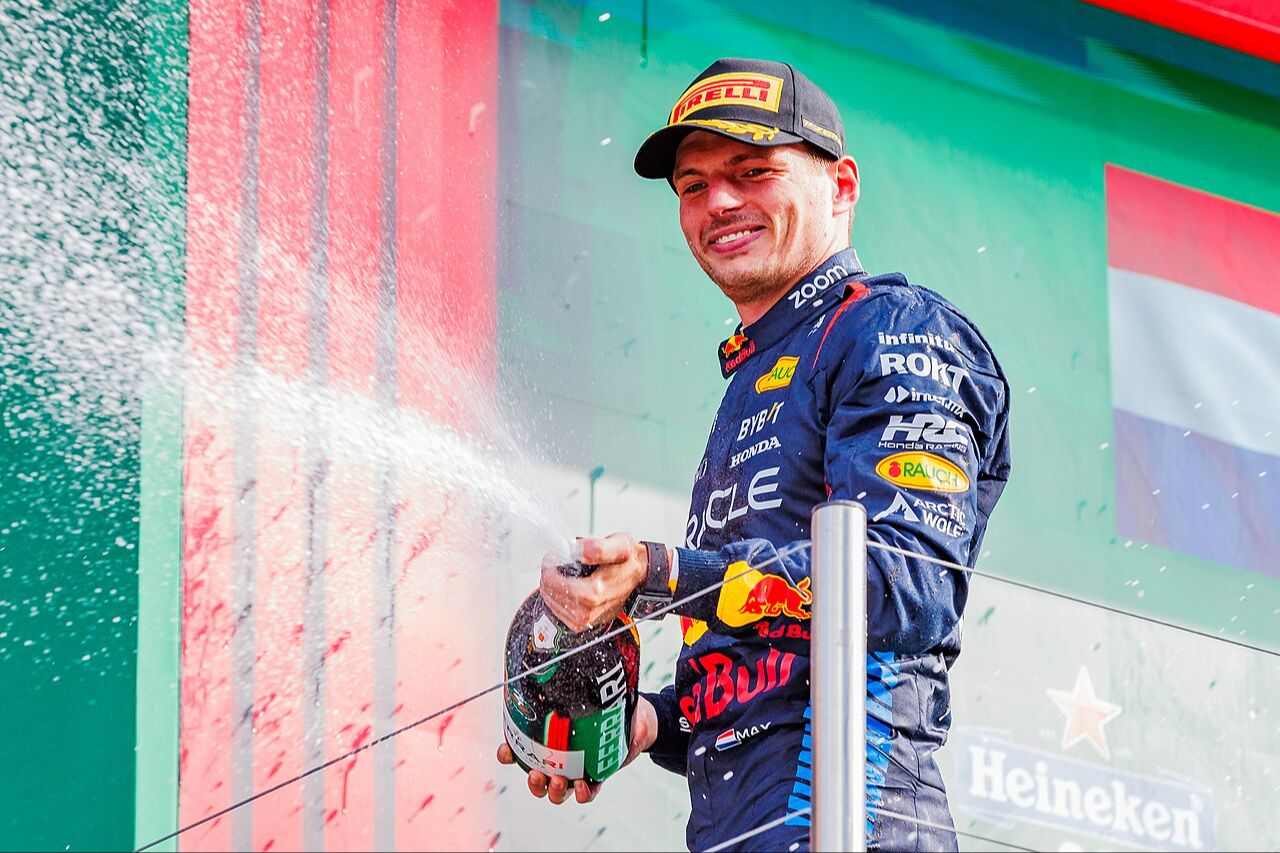
This is exactly what Lewis Hamilton was aiming for when he held his breath the entire last lap of the 2023 qualifications for GP Hungary.
With a time of 76.6 seconds, he snatched pole position from the – at the time – seemingly unstoppable Max Verstappen.
At first, you may think that 1 minute and 16 seconds does not sound like a very long hold.
Now take in consideration being subject to gravity up to five times your weight.
Once you achieve a state of flow, all of this disappears.
There is only a single, laser focus going towards your goal.
The Breath Hold Does Not Lie
Formula One and breath-holding have another thing in common: they are a truth machine.
You can’t fake it until you make it when your car slides over the track at warp speed.
At over 300 km/h, you either know what you are doing … or you crash. Big time.
The breath-hold is similarly beautiful.
If you are not in a good place mentally, you won’t be breaking any breath-holding records.
In similar fashion; if you put in the work, your mental game will go through the roof.
Formula One Breathwork Exercises
Box Breathing (4:4:4:4 Ratio Breathing)
The breathing technique made famous thanks to its endorsement by Navy SEALs is also a mainstay on the racing circuit, and for good reason.
Instructions
- Inhale through the nose for 4 seconds
- Hold your breath for 4 seconds
- Exhale for 4 seconds
- Hold your breath on exhale for 4 seconds.
High-Positive Breathing (Two Quick Deep Breaths)
Thanks to the immense G-forces the drivers have to deal with in the corners, they end up out of breath for most of the race. Thank the stars for the straights.
During the six seconds or so, these parts of the track allow for some quick deep breaths to fuel the oxygen tank.
Instructions:
- Take an inhale for 1 to 1.5 seconds
- Exhale for the same length
- Repeat 2 to 3 times
It is crucial to keep the exhale the same as the inhale to prevent hyperventilation; which would make a bad situation (low oxygen) worse with rapid CO2 depletion.
Low Positive Breathing (1:1:2 Ratio Breathing)
When F1 drivers near a corner and have to prepare for an inevitable breath hold, they utilize low positive breathing with an extended exhale to tap into the parasympathetic nervous system.
Instructions:
- Take a slow deep inhale
- Hold your breath for the same length as the inhale
- Exhale through the lips for twice the length as your inhale
Become a Champion of Flow
I would not have been able to set my Guinness World Records & become the first person to hold their breath for over 20 minutes if I wasn't able to achieve flow on command
Over the years, I have trained athletes, business leaders, singers, and many more to do the same.
To make these teaching more accessible, I have condensed my 30+ years of experience into the 30-day Breathwork Fundamentals Program .
Save $300 today, and, as a special bonus, also access to the Flow on Command mini course and the 5-Sense Flow Framework.
Start Your Transformation